180 Days, One Shawl: The Meticulous Art Behind Authentic Kashmiri Pashmina
Introduction
-
The Hook: Contrast instant fast fashion with a craft where a single garment takes over 180 days (or half a year) to make.
-
The Thesis: The value of a genuine Kashmiri Pashmina comes not from a brand label, but from an arduous, entirely hand-driven journey that transforms raw high-altitude fleece into wearable art.
-
Overview of what the reader will discover: The origin of the fiber, the traditional hand-spinning process, the loom work, and why true patience is the core ingredient.
Phase 1: The Mountain Origin (Days 1–15)
-
The High-Altitude Source:
-
Gathered from the Changthangi (Pashmina) goat residing in the harsh winters of Changthang, Ladakh (over 14,000 feet high).
-
-
Combing, Not Shearing:
-
Explain that the delicate underfleece (12–15 microns thick) is gently combed out by hand during spring molting, rather than shorn.
-
-
Raw Yield:
-
Highlight that one goat yields only about 150–200 grams of usable fleece per year, emphasizing its natural scarcity.
-
Phase 2: De-hairing & Cleaning (Days 16–30)
-
Sorting the Fiber:
-
Manual separation of fine Pashm fibers from coarse guard hairs.
-
-
Traditional Rice Powder Treatment:
-
Washing raw fibers with ground rice flour to absorb excess oil and condition the ultra-delicate fleece without using harsh industrial chemicals.
-
Phase 3: The Art of Hand-Spinning (Days 31–75)
-
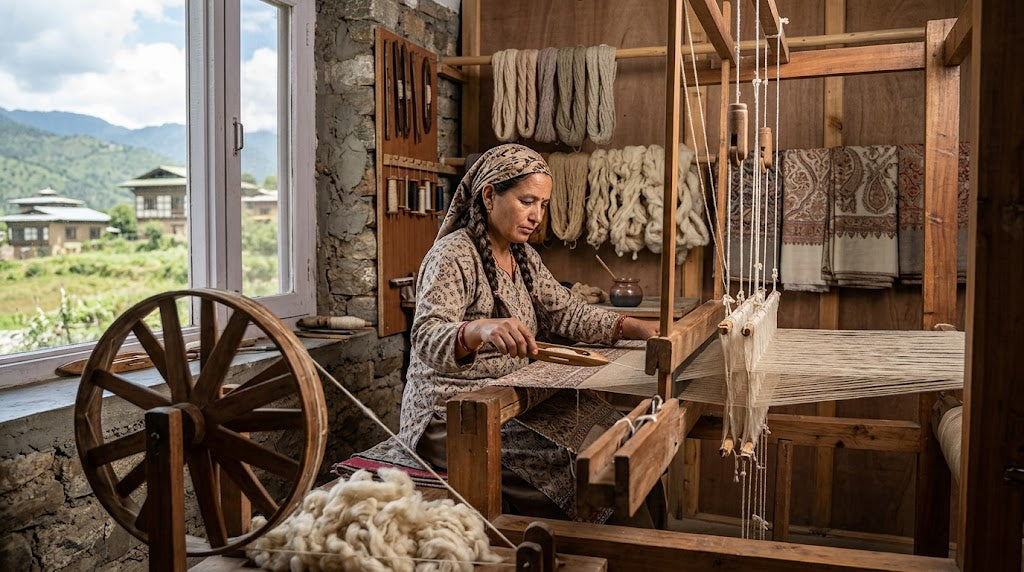
The Charkha (Yunj):
-
How artisan women spin raw fleece onto a traditional wooden spinning wheel.
-
-
Unrivaled Delicate Precision:
-
Why Pashmina yarn is too fragile for industrial machines—it demands the delicate, intuitive tension of human fingers.
-
-
Time Commitment:
-
Dozens of hours dedicated solely to producing enough fine, consistent yarn for a single shawl.
-
Phase 4: Setting the Loom & Hand-Weaving (Days 76–135)
-
Warping (Taang):
-
Threading thousands of delicate warp threads onto traditional wooden handlooms (Hand loom).
-
-
The Weave Pattern:
-
Explaining the traditional Chashm-e-Bulbul (Eye of the Nightingale) weave—a subtle diamond pattern that gives Pashmina its drape and strength.
-
-
Rhythm of the Loom:
-
Master weavers sitting side by side, passing the wooden shuttle by hand, weaving row by precise row over weeks.
-
Phase 5: Washing, Dyeing & Finishing (Days 136–180)
-
Spring-Water Washing:
-
Washing the woven fabric in natural running spring water to soften the fibers and remove rice starch.
-
-
Hand-Dyeing (Optional):
-
Using traditional natural or specialized dyes mixed in small batches by master dyers (Rangur).
-
-
Fringing & Hand-Tweezing:
-
Finishing borders by twisting threads into neat tassels and inspecting every square inch with tweezers to remove tiny knots.
-
Why 180 Days Matter: Fast Fashion vs. Heirloom Luxury
-
Summary Table / Comparison:
-
Machine-made Wool: Mass-produced in hours, short lifespan, synthetic blends.
-
Authentic Kashmiri Pashmina: Months of handcrafting, lasts generations, natural thermal regulation, lightweight warmth.
-
-
The Emotional & Cultural Value:
-
Supporting generations of artisan families in the Kashmir Valley.
-
Owning a piece of living history rather than disposable apparel.
-
-
Posted in
180 days, pashmina shawls, sozni